Announcing the Korean edition of Quantum Computing and Information: A Scaffolding Approach (2e).
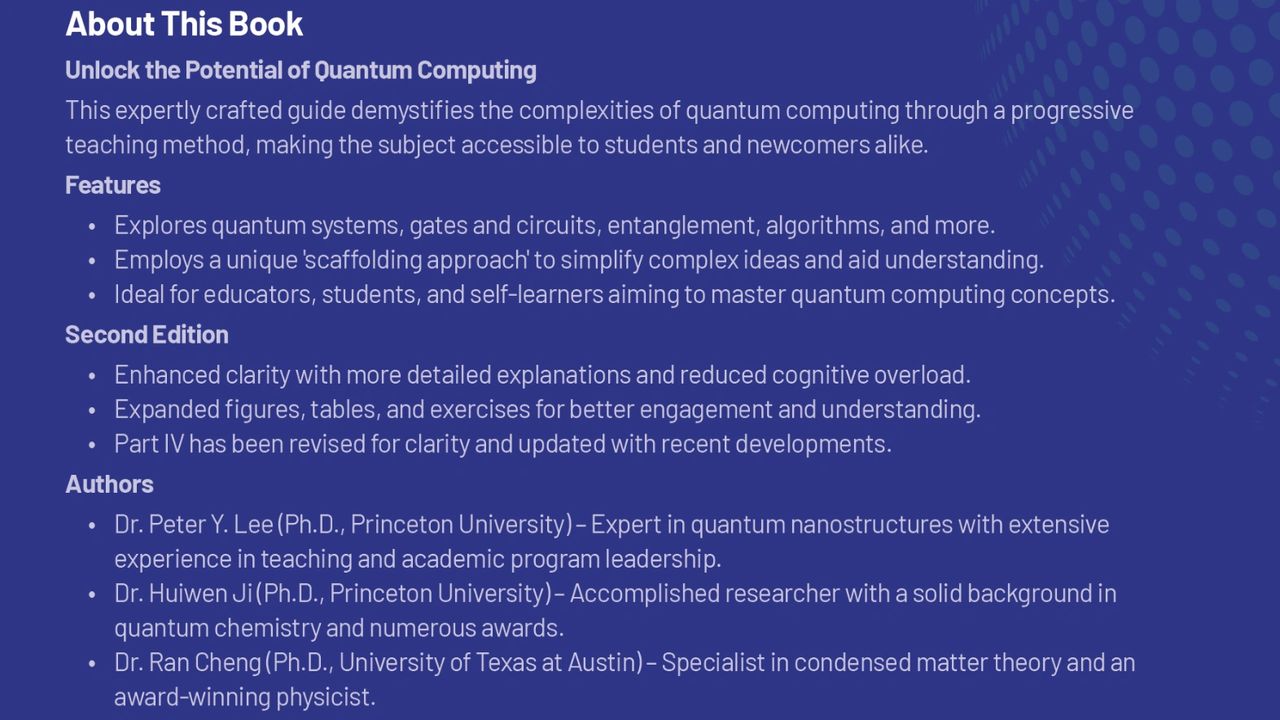
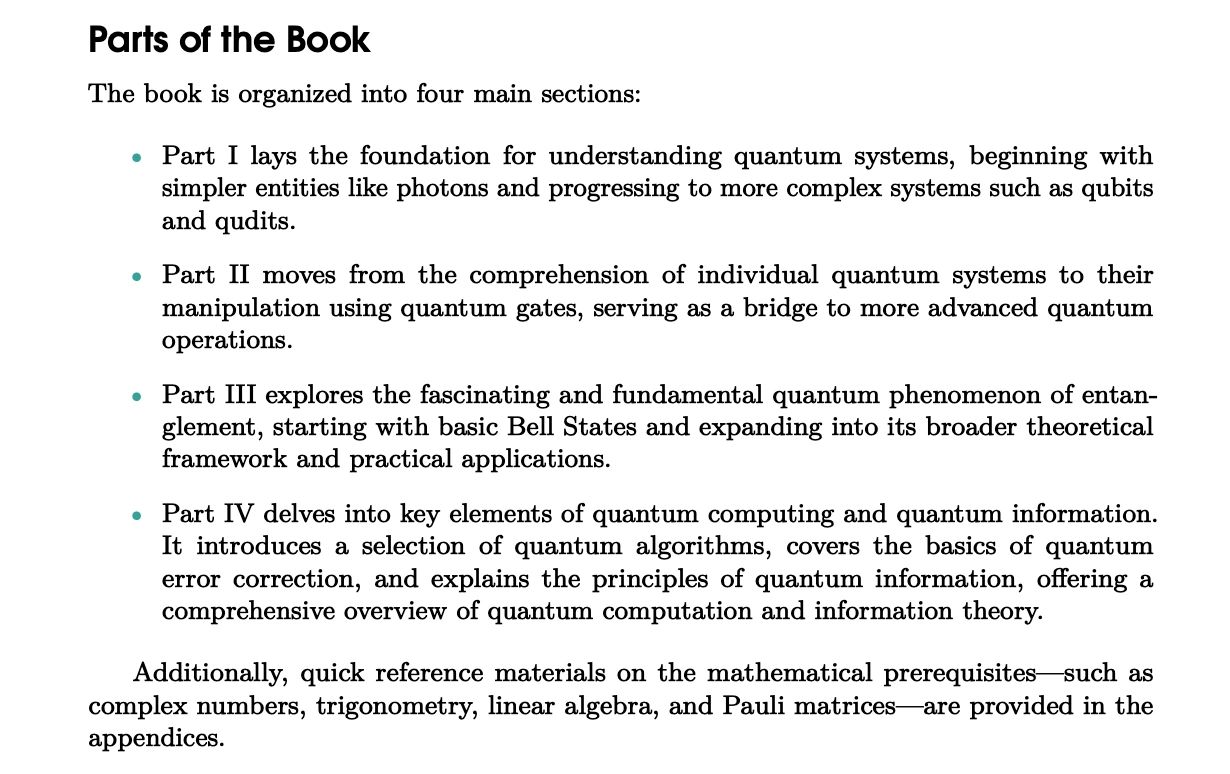
Built on a deliberate scaffolding pedagogy, the book breaks complex ideas into a progressive, practice-connected sequence—ideal for senior undergraduates, graduate students, and self-learners. The 2nd edition adds clearer exposition, more figures and exercises, and updated material in Part IV.
Publisher: Human Science (휴먼사이언스)
Korean Title: 양자컴퓨팅 및 정보 — 스캐폴딩 접근 방식 (2판)
Availability: YES24 and Aladin
Translator
Dr. June-Gone Chay (채준곤), Korea University, Department of Physics.
Dr. Chay received his B.S. in Physics from Seoul National University (1984), M.A. in Physics from Harvard University (1986), and Ph.D. in Particle Physics from Harvard University (1990). He was a postdoctoral researcher at the University of Washington (1990–1992) and has been a Professor of Physics at Korea University since 1992. His translation portfolio includes the Korean editions of Introduction to Quantum Mechanics (3rd ed.) by David J. Griffiths & Darrell F. Schroeter and Mathematical Methods in the Physical Sciences by Mary L. Boas, among other titles.
Preface in the Korean Version
I was asked by a physicist with many years of experience teaching quantum mechanics to translate a textbook on quantum computing, and I was deeply troubled. However, there were several reasons why I ultimately decided to undertake this project. First, while quantum computing is based on quantum mechanics, quantum mechanics encompasses many other areas, including quantum computing itself. Even if you are familiar with quantum mechanics, translating a book on quantum computing presents a different challenge. However, after reading the textbook, I realized that the book's explanations are heavily based on quantum mechanics, so I assumed the translation would be easy. (Of course, the translation process proved this to be completely wrong.) Therefore, in the process of translating this book, the translator resolved to broaden his understanding and, based on this, explore new research areas. Second, as of 2025, research on quantum computing is very active, and a fierce academic debate is underway regarding whether it can perform useful calculations. The academic community is also seriously considering teaching about it. However, the lack of suitable textbooks on quantum computing, coupled with the varying prerequisites for quantum mechanics and entry points into quantum computing, deeply resonated with the translator, who realized that students would struggle to get started.
This textbook approaches quantum computing in a orthodox manner. This means beginning with a physical discussion of fundamental quantum mechanics concepts, such as superposition and entanglement, and completing a formalization based on linear algebra. Through this, it covers various quantum computing topics, such as quantum gates and quantum algorithms. The translator hopes that beginning graduate students and third- and fourth-year undergraduates will gain a fundamental understanding of quantum computing from this book. This book is part of a three-volume series focused on quantum computing. The other volumes cover the mathematical foundations for studying quantum computing, much like industrial mathematics in engineering schools or mathematical physics in physics departments. The third volume covers the applications and cutting-edge fields of quantum computing. Therefore, I encourage readers to start with this book and enjoy quantum computing and immerse themselves in this bizarre and fascinating field.
July 2025
Joon-Gon Choi
From the Authors
Welcome to Quantum Computing and Information: A Scaffolding Approach, a gateway to the domain where computation meets quantum mechanics. This book is crafted for graduate students, senior undergraduates, and motivated learners who seek a structured path into the field.
What Makes It Different
Many texts introduce quantum computing; far fewer organize the learning process around a deliberate scaffolding model. We decompose concepts, reinforce them progressively, and connect theory with practice. The aim is durable understanding—useful for students, educators, and independent learners.
Learning Journey
The book begins with fundamentals and builds step by step through quantum states and gates, entanglement, circuits, and core algorithms. The objective is to help readers construct a solid conceptual base while developing practical fluency.
Accessibility
Quantum computing can be challenging. With the scaffolding approach—supported by illustrations, worked examples, and exercises—we guide readers toward clarity without sacrificing rigor.
About the Book