

This is a repost of a blog post with the same title, originally written by Professor Fujio Yamamoto, emeritus of Computer Science at Kanagawa Institute of Technology in Japan. (Original post here.)
The number of books on quantum computing has been steadily increasing. Here, I’d like to briefly introduce two books I recently purchased, both of which I found to be excellent.
Peter Y. Lee, Huiwen Ji, Ran Cheng: Quantum Computing and Information, Polaris QCI Pub., 2nd edition, Feb. 2025
First off, I was excited to see the publication date listed as 2025—and the book certainly lives up to that excitement! With 502 pages, its thickness alone hints at the density of its content. The material ranges from beginner to intermediate levels and is presented with numerous illustrations, making it a great choice for those who want to study carefully and in depth.
The book begins by explaining the basic concept of quantum bits using photon polarization. It then progresses through topics such as quantum superposition, measurement, quantum gates, and quantum circuits. At this stage, it derives BB84, one of the foundational protocols for quantum key distribution.
Next, it devotes around 80 pages to a detailed discussion of quantum entanglement, including a thorough explanation of Bell's inequality. It also covers E91 (Ekert’s protocol), another important technique in quantum key distribution, as well as quantum teleportation—with clear examples using IBM Qiskit code.
Impressively, the book also ventures into applications from the NISQ era, including hybrid algorithms such as the Variational Quantum Eigensolver (VQE) and Adiabatic Quantum Computation (AQC), as well as quantum error correction techniques like the Bit-Flip, Phase-Flip, and Shor Code.
On the other hand, since it does not cover the Quantum Fourier Transform (QFT) or Shor’s algorithm for prime factorization, it may be a bit lacking for intermediate to advanced readers. That said, the co-authors are reportedly preparing a follow-up book focusing on more advanced applications, to be published by the same publisher. I’m very much looking forward to that release as well. (Book author's note: QFT, QPE, Shor, etc., are covered in the 3rd book of the Scaffolding Series: Quantum Algorithms and Applications.)
Qiskit Examples
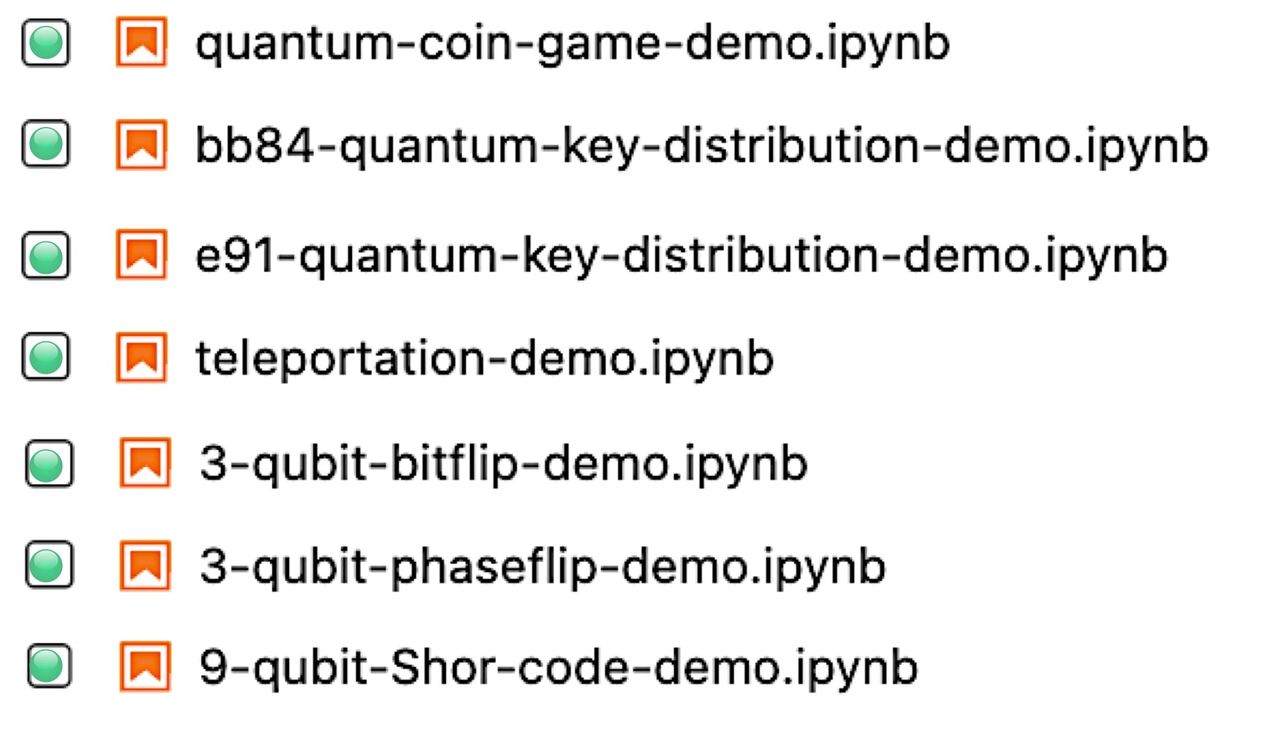
One important point worth mentioning: in many newer books, the example programs often contain errors or fail to run in readers’ environments, largely due to frequent updates in quantum computing platforms. However, the code provided in this book is carefully updated to match the latest Qiskit environment, and every example worked flawlessly in my local setup! This is incredibly important, as it motivates deeper exploration of the book’s contents.
Jack D. Hidary: Quantum Computing - An Applied Approach, 2nd edition, Springer, Aug. 2021
This second book is also a thick, full-color hardcover with a total of 422 pages, targeting beginners to intermediate learners. The latter 170 pages provide a detailed introduction to the basics under the section titled Mathematical Tools for Quantum Computing, so it may be a good idea to review this part first.
The quantum algorithm section in the first half overlaps somewhat with the content of the aforementioned book by Lee et al., but I was happy to see that it includes QFT (Quantum Fourier Transform) and Shor’s Algorithm, which were not covered in that book. For instance, it walks through the entire process (quantum + classical parts) of factoring the small integer 15 (= 3×5), which greatly enhances reader's understanding of the Shor algorithm. Moreover, the second edition includes new content related to Quantum Machine Learning, which is a big plus.
(Note) Factoring a slightly larger integer like 184573 (= 487×379) is considered difficult in simulations due to memory limitations, and on current quantum computers due to limitations in qubit count and error rates. However, simulation is still possible by replacing "quantum order finding" with "classical order finding."
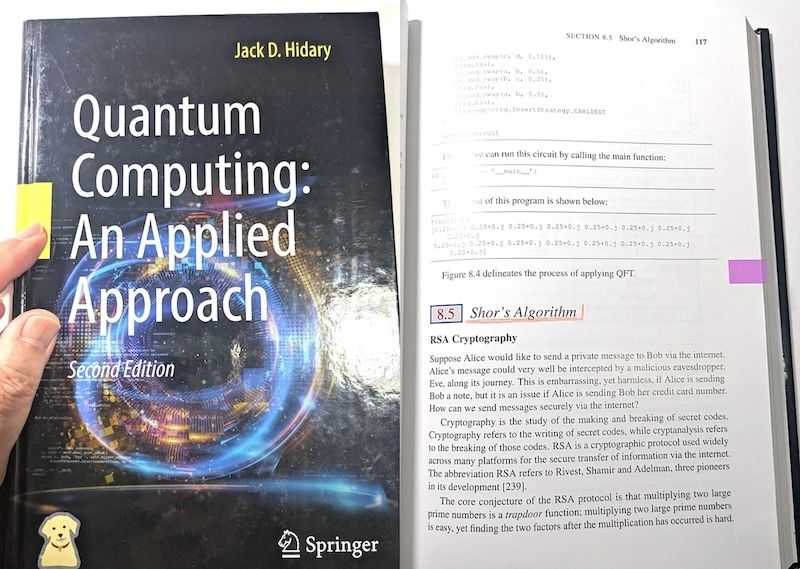
By the way, when you open this book, the Schrödinger equation appears right at the beginning—in other words, the wave function and the Hamiltonian. Since most books on quantum computing are computer science–oriented, this equation is rarely mentioned, which is a bit surprising. However, this is actually a very good thing, because both the quantum gate model and the quantum annealing method are said to originate from the time-dependent Schrödinger equation. Though the explanation spans only four pages, it clearly demonstrates, with a few equations, that “to understand the time evolution of a wave function, one must consider the total energy of the system.” Specifically, it derives the case of a harmonic oscillator potential, as shown below.
Cirq Examples
Also, please note that the quantum algorithm programs provided in the book are written in Google’s Cirq, not IBM’s Qiskit as mentioned earlier. These programs were created in an older Cirq environment than mine, and I encountered various errors when trying to run them. However, the official Google Cirq site provides examples very similar to those in the book, and I was able to run them perfectly in my Cirq setup! Using those as a reference, you should be able to run the remaining examples in the book as needed.